
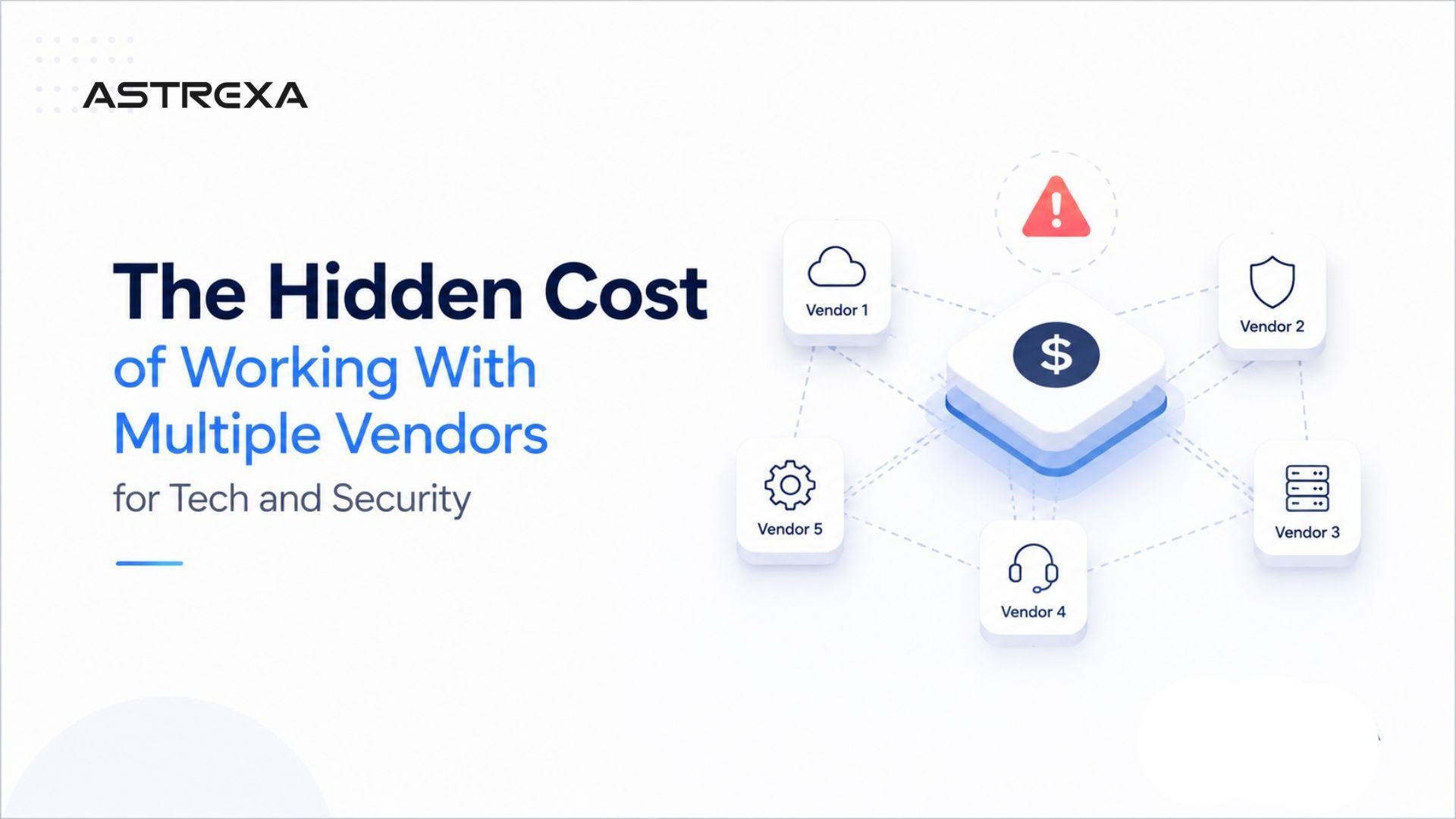
Most enterprises don't set out to work with a dozen different vendors. It happens gradually. A cloud migration project brings in one consulting firm. A cybersecurity gap gets patched by a specialist boutique. A new CRM needs a systems integrator. An AI pilot gets outsourced to a startup that "just does AI." Two years later, IT leadership looks up and realizes they're managing relationships with 8, 10, sometimes 15 different vendors — each with their own contract, their own point of contact, their own understanding of the business (or lack thereof).
On paper, this looks efficient: best-of-breed specialists for every need. In practice, it's one of the most expensive and under-recognized inefficiencies in enterprise technology and security spending. The costs aren't always visible on an invoice. They show up as delays, security gaps, duplicated work, and decisions made without anyone having the full picture.
This article breaks down exactly where those hidden costs come from — and why a growing number of enterprises are consolidating toward integrated technology and security partners instead.
Why Vendor Sprawl Happens in the First Place:
Nobody plans to end up with a fragmented vendor ecosystem. It accumulates through a series of individually reasonable decisions.
Point solutions get bought reactively. A security incident happens, so a specialist cybersecurity vendor gets brought in fast. A system breaks, so an emergency integration partner gets hired. Each decision solves an immediate problem without anyone stepping back to ask how it fits into the broader technology and security strategy.
Specialization feels safer. There's a natural instinct to hire "the best" firm for each narrow need — the AI specialist, the pentest boutique, the ERP implementer. Individually, these firms may be excellent at their specific discipline. But nobody is accountable for how the pieces fit together.
Procurement optimizes per-project, not systemically. Most procurement processes evaluate each vendor decision in isolation — cost, timeline, and capability for this project — without factoring in the cumulative overhead of managing yet another vendor relationship long-term.
Legacy relationships never get re-evaluated. Vendors that were the right fit five years ago often stay in place simply because switching feels disruptive, even as the business's needs — and the vendor's relevance — have shifted.
The result is a technology and security stack held together by a patchwork of vendors, each optimizing for their own slice of the problem, with no single party responsible for the whole.
The Hidden Costs of Multi-Vendor Fragmentation:
1. Security gaps at the seams
This is the most consequential hidden cost. When your application development, your infrastructure, and your security function are handled by three different vendors, security often gets treated as a downstream concern — something reviewed after a system is built, rather than designed in from the start.
Worse, each vendor typically only sees their own piece. The systems integrator doesn't have visibility into the cybersecurity vendor's risk assessments. The application developer doesn't know what the compliance consultant flagged last quarter. Vulnerabilities frequently live in the gaps between vendor responsibilities — the handoff points nobody fully owns. A breach investigation that reveals "it wasn't technically anyone's job to check that" is one of the most common and most preventable failure patterns in enterprise security.
2. Slower decision-making and finger-pointing during incidents
When something goes wrong — a system outage, a security incident, a failed integration — multi-vendor environments create an immediate coordination problem. Which vendor is responsible? Whose SLA covers this? Is it a security issue, an infrastructure issue, or an application bug?
In the critical first hours of an incident, enterprises with fragmented vendors often lose time simply figuring out who needs to be on the call, rather than actually resolving the problem. Every vendor has an incentive to establish that the issue originated outside their scope. That friction directly extends downtime and increases the cost of every incident.
3. Duplicated tools, licenses, and effort
Different vendors frequently bring — or recommend — their own preferred tools, platforms, and licenses, even when the organization already has a functioning solution in place. Over time, this creates redundant software spend: multiple monitoring tools doing overlapping jobs, multiple identity systems that don't talk to each other, multiple reporting dashboards that all claim to be "the source of truth."
Beyond the direct licensing cost, this duplication creates data fragmentation — different systems holding different, sometimes contradictory, versions of the same operational reality.
4. No single accountable strategy
Perhaps the most strategic cost: with a fragmented vendor ecosystem, no single partner has visibility into your full technology and security posture. Nobody is positioned to say, "Here's how your AI initiative, your legacy system integration, and your security posture actually connect — and here's where the risk is concentrated."
Each vendor optimizes for their contract scope. None of them are incentivized — or equipped — to flag that a decision in one area creates risk in another. Strategic blind spots accumulate simply because nobody's job is to see the whole picture.
5. Rising management overhead that scales with vendor count
Every vendor relationship carries fixed overhead: contract negotiation and renewal, security and compliance review of the vendor itself, onboarding their team to your environment, ongoing relationship management, and eventual offboarding if the relationship ends. This overhead doesn't scale linearly — it compounds. Ten vendor relationships aren't twice as much management burden as five; the coordination complexity grows faster than the vendor count itself.
Internal teams — IT leadership, procurement, legal — end up spending a disproportionate amount of time managing vendors rather than managing outcomes.
6. Inconsistent quality and cultural fit
Every vendor brings a different level of seniority, a different communication style, and a different understanding of your business context. Some engagements are staffed by senior practitioners; others get junior teams learning on your dime. This inconsistency makes it hard to build institutional trust or a predictable way of working — every new engagement effectively starts from zero.
What This Costs in Practice:
These costs rarely show up as a single line item, which is exactly why they go unaddressed for so long. Instead, they show up as:
Security incidents that trace back to unclear ownership at a vendor handoff point
Projects that run over budget because of duplicated work across vendors solving overlapping problems
Slower incident response due to coordination overhead across multiple vendor SLAs
Strategic initiatives (AI adoption, digital transformation, Zero Trust rollouts) that stall because no single partner can see the full technical and security picture
Procurement and legal teams spending disproportionate time on vendor management rather than strategic work
Individually, none of these look catastrophic. Cumulatively, across a multi-year technology roadmap, they represent a meaningful drag on both cost and execution speed — one that's largely invisible until an organization actually consolidates and can compare the before-and-after.
A Practical Example: The Seam Nobody Owned:
A mid-sized enterprise brought in three separate vendors over 18 months: a systems integrator to modernize a legacy order-management platform, an application developer to build a new customer-facing portal on top of it, and a cybersecurity firm to run periodic assessments.
Each vendor delivered exactly what their contract specified. The integrator connected the legacy platform to modern infrastructure. The application developer built a fast, well-designed portal. The security firm ran its scheduled assessment and found no critical issues — because its scope covered the portal's application layer, not the newly modernized integration layer underneath, which had gone live two months after the last assessment was scoped.
Nine months later, an attacker exploited an authentication weakness at exactly that integration point — the seam between the modernized legacy platform and the new portal. It wasn't in the integrator's contract to secure it long-term. It wasn't in the developer's scope to test it. It wasn't in the security firm's assessment window. Three vendors, each competent within their lane, and a gap that existed precisely because no one was responsible for the connections between the lanes.
This is the pattern that shows up repeatedly in multi-vendor environments: individual components pass their individual reviews, while the risk concentrates in the handoffs — the parts of the system that belong to everyone and no one.
Why Consolidation Toward Integrated Partners Is Gaining Traction:
A growing number of enterprises — particularly in fast-growing, high-stakes markets like the GCC — are shifting away from best-of-breed vendor sprawl toward working with a smaller number of integrated partners capable of covering both technology delivery and security across the full stack.
The logic is straightforward: when the same partner is responsible for building a system and securing it, security stops being a downstream afterthought and becomes a design constraint from day one. When the same partner understands your infrastructure, your applications, and your risk posture, strategic recommendations account for the full picture rather than a narrow slice of it. And when incidents happen, there's a single accountable party — not a coordination exercise across contracts.
This doesn't mean every enterprise should collapse to a single vendor for everything. It means being deliberate about which relationships genuinely benefit from specialization, and which ones create more risk and overhead than they're worth by being split apart.
How Astrexa Facilitates This
Astrexa was structured specifically to close this gap.
Our two service pillars — Engineering (Technology Consulting, AI & Business Automation, Enterprise Application Development, and System Integration) and Protection (Cybersecurity, Risk Management, and Compliance & Governance) — exist under one roof precisely so our clients don't have to stitch together the seams themselves.
We design systems with security built in, not bolted on. Because our engineering and security teams work from the same engagement, applications and infrastructure we build are designed against Zero Trust principles from the outset — not reviewed for security gaps after the fact by a separate vendor with no context on the original build decisions.
We give you one accountable partner during incidents. When something goes wrong, there's no ambiguity about which vendor owns which layer of the stack. Our team already has full visibility into how your infrastructure, applications, and security posture connect — which means faster diagnosis and faster resolution, without a multi-vendor coordination exercise eating into your response time.
We connect strategic decisions across disciplines. An AI automation initiative gets evaluated not just for technical feasibility, but for its security and compliance implications, because the same organization is advising on all three. A legacy system integration project accounts for the vendor and third-party risk it introduces, because our Risk Management practice is part of the same conversation, not a separate afterthought.
We reduce the management overhead of vendor sprawl. Instead of managing multiple contracts, multiple points of contact, and multiple onboarding cycles across seven or eight specialist firms, our clients work with one senior team that understands their business context across every engagement — reducing the coordination burden on internal IT, procurement, and legal teams.
We staff every engagement with senior practitioners, not layered teams of juniors learning on the job — so the quality and cultural fit stays consistent whether the engagement is a cybersecurity assessment, an application build, or a compliance audit.
The goal isn't to be the only vendor you'll ever need. It's to eliminate the seams where cost, risk, and delay actually accumulate — so your technology and security strategy is built and executed as one coherent system, not a patchwork of disconnected contracts.
Curious what consolidating your technology and security vendors could actually save you — in cost, risk, and speed? Get in touch with our team for a free consultation.
Written by
Suniti Roy Chowdhury
.png&w=3840&q=75)
.png&w=3840&q=75)