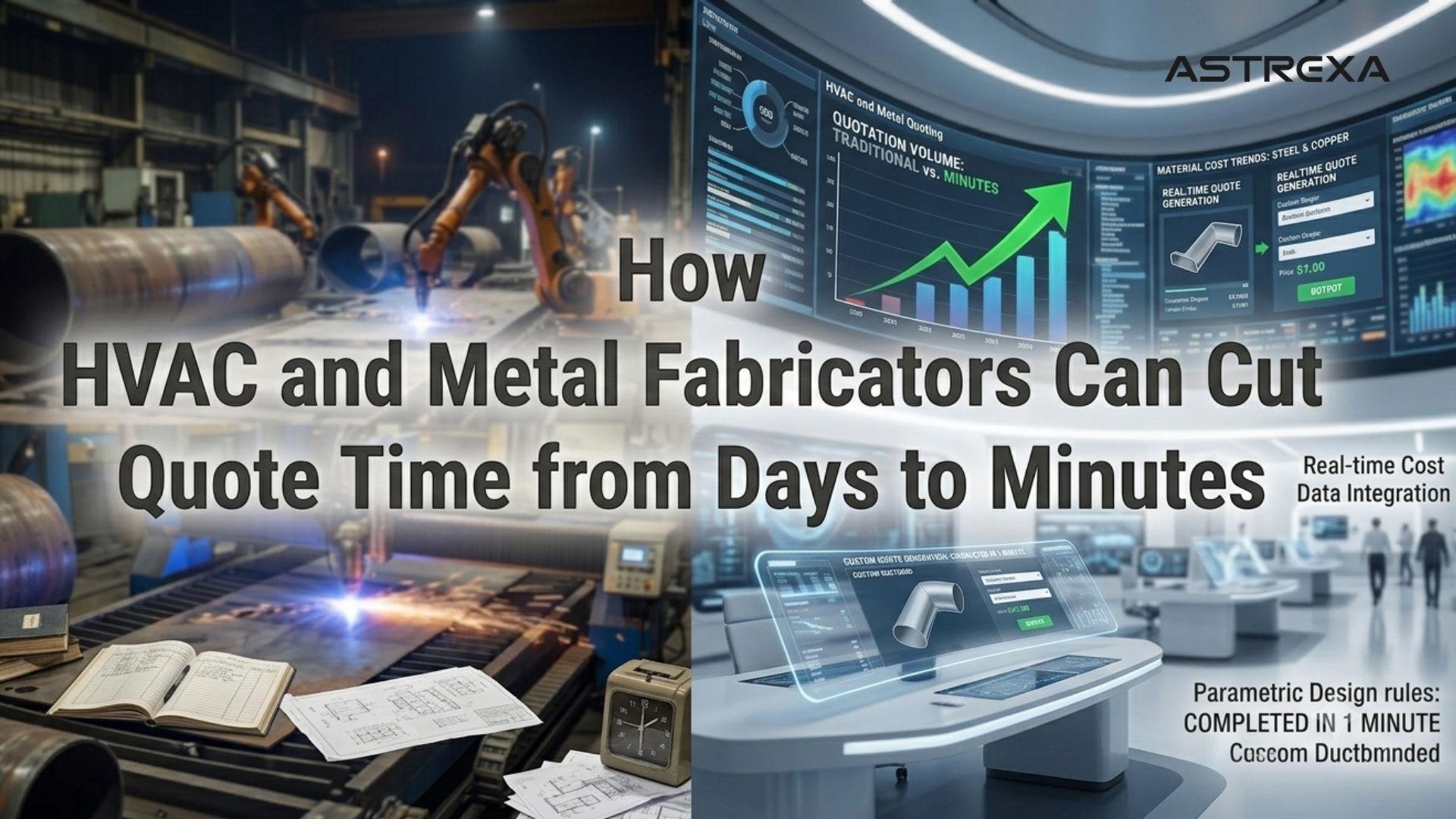
HVAC and fabrication quotes are slow because every job has different dimensions, fittings and specifications, so estimators rebuild material and labour calculations by hand. Capturing those calculations as parametric rules — sheet area, gauge, fittings, insulation, labour — lets a fabricator produce a complete, consistent quote in minutes from a schedule or drawing.
Key takeaways
■ Duct and fabrication quoting is rules-heavy work, which is exactly what software does well.
■ The biggest time sinks are taking off quantities, rebuilding BOMs, and repricing after revisions.
■ Revisions and variations on GCC projects must be tracked against the original quote, or margin disappears.
■ Quoting speed wins work: main contractors often shortlist whoever returns a credible price first.
■ Start with your highest-volume product family — usually rectangular duct and standard fittings.
Why fabrication quotes take so long
A typical HVAC ductwork enquiry arrives as a drawing set, a duct schedule, or a spreadsheet from an MEP contractor. The estimator then has to:
1. Take off every section, bend, reducer, branch and accessory with its dimensions.
2. Work out sheet area and select gauge for each item according to the specification.
3. Add flanges, fixings, sealant, supports and insulation where required.
4. Estimate fabrication and installation labour.
5. Apply current material prices, overheads and margin.
6. Format the quote with terms, validity, VAT and exclusions.
Each step is straightforward. Doing all of them for hundreds of items, accurately, under time pressure, is not — and when the contractor sends a revised drawing two days later, much of it starts again.
Where the margin quietly goes
■ Gauge and material errors. Under-specifying gauge on large sections understates cost; over-specifying loses the job.
■ Forgotten items. Supports, access doors, dampers, sealant and insulation fixings are easy to miss on a long schedule.
■ Stale prices. Galvanised steel and insulation prices move; spreadsheets rarely do.
■ Untracked variations. On GCC projects, drawing revisions and site variations are routine. If they are not priced against the original quote, they are absorbed as cost.
■ Inconsistent labour assumptions. Two estimators pricing the same job can differ significantly.
What changes with parametric quoting
With the rules captured once, each duct item becomes a set of parameters — width, height, length, type, insulation — and the system calculates the rest.
Task | Manual spreadsheet | Parametric quoting |
|---|---|---|
Sheet area and gauge | Calculated per line by the estimator | Calculated by rule, consistently |
Fittings and accessories | Added from memory or a checklist | Included automatically where rules require |
Material prices | Updated occasionally | Updated once, applied everywhere |
Revisions | Rework affected lines by hand | Change parameters; recalculate instantly |
Variations | Often tracked separately, if at all | Linked to the original quote with a clear history |
Output | Formatted manually | Branded quote with VAT, terms and exclusions |
Where AI helps fabricators
The slowest step is often reading the enquiry itself. AI can extract dimensions and quantities from duct schedules, spreadsheets and PDFs into a structured list for the estimator to review, removing much of the typing. The pricing still comes from your rules — which is how it should be when you have to stand behind the number with a main contractor.
GCC project realities to build in
■ VAT: 5% UAE VAT applied correctly on quotes and invoices, with appropriate treatment for other GCC countries.
■ Retention and payment terms: make them explicit on every quote, since they affect real margin.
■ Validity periods: material price volatility makes short validity periods important.
■ Revision control: every revision numbered and traceable, so disputes can be settled from records rather than memory.
■ Bilingual documents where the client or project requires them.
How to get started
7. Pick your highest-volume family — usually rectangular duct and standard fittings.
8. Collect twenty recent quotes as test cases.
9. Have your senior estimator walk through how they price three of them, and write the rules down.
10. Model those rules, test them against the historical quotes, and run both methods side by side for a few weeks.
11. Add circular duct, specials and accessories once the core is trusted.
Frequently asked questions
What is the best software for HVAC duct quoting?
The best fit depends on how much of your work is standard versus custom. For fabricators whose jobs vary by dimension and specification, look for software built on parametric rules that calculates sheet area, gauge, fittings and labour automatically, and that tracks revisions and variations.
Can quoting software read duct schedules and drawings?
Many modern tools can import schedules from spreadsheets, and AI-assisted tools can extract dimensions and quantities from PDFs and emails for an estimator to review. Full automatic take-off from complex drawings remains less reliable and should be checked.
How do fabricators handle variations on GCC projects?
Best practice is to link each variation to the original quote with a revision number, price it using the same rules, and record approval. This protects margin and provides evidence if the final account is disputed.
Is quoting software worth it for a small fabrication shop?
Often yes, because small shops depend heavily on one or two estimators. Capturing their rules speeds up quoting, reduces errors and lets the business take on more enquiries without adding estimating staff.
See your own ductwork quoted in minutes
AI-powered Elevate was shaped by work with HVAC and fabrication businesses in the UAE. Bring a recent duct schedule to a demonstration and see it priced using parametric rules.
Written by
Nilanjan Mukherjee
Chief Executive Officer