
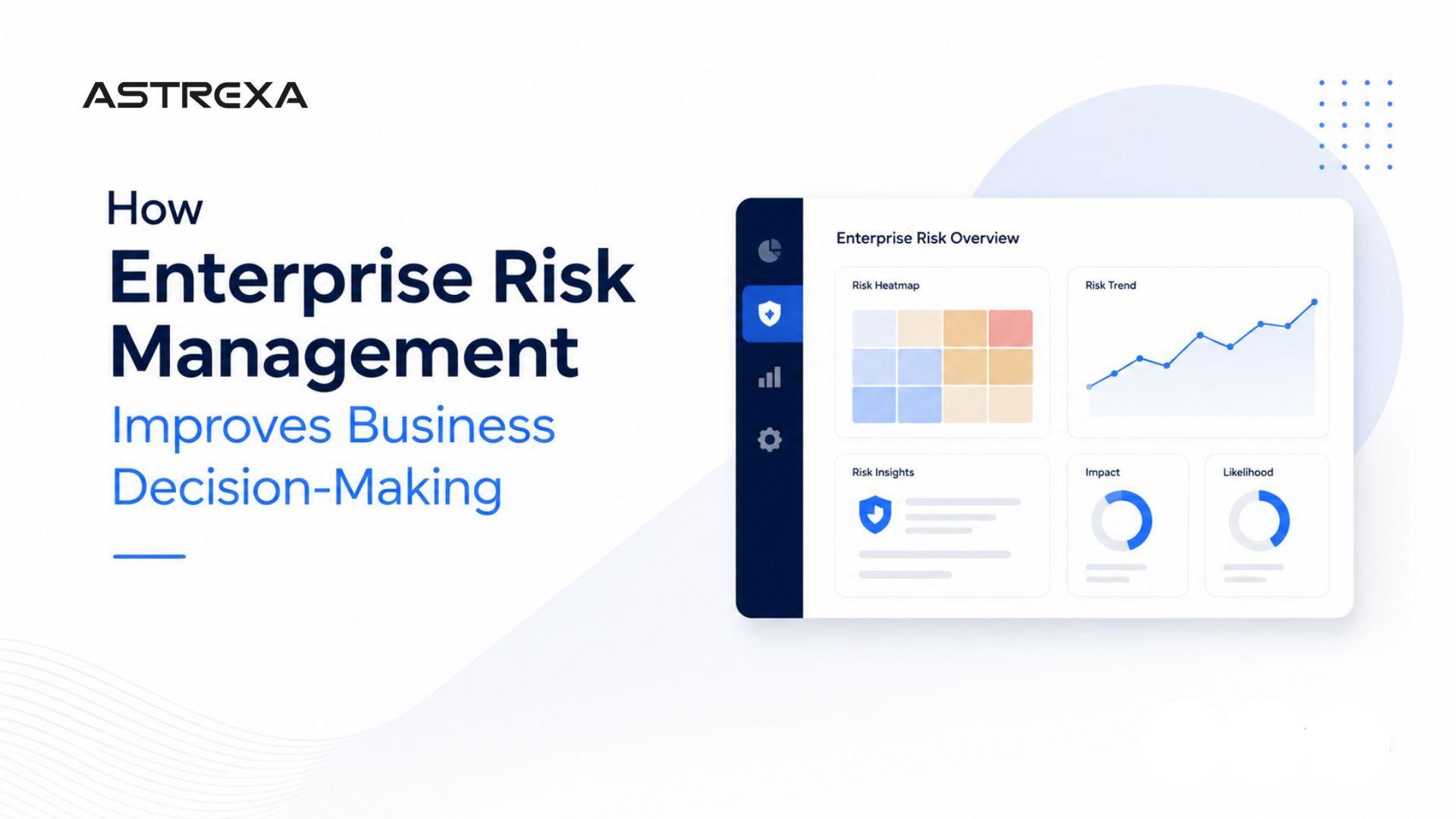
Most companies treat risk management as a compliance afterthought — reviewed after a decision is made, not before. This post argues that Enterprise Risk Management (ERM), done properly, is actually a decision-making tool: it replaces gut-instinct calls with structured evaluation, surfaces risks while they're still cheap to fix, clarifies risk appetite so approvals move faster, and maps how risks in one area (like vendor concentration) cascade into others (operational, financial, reputational). A side-by-side example shows two companies facing the identical regulatory disruption — one blindsided, one prepared — to illustrate the real cost of skipping structured risk evaluation. Closes with a practical framework outline and a case for moving from reactive compliance to proactive resilience.
What Enterprise Risk Management Actually Means
Enterprise Risk Management is the practice of identifying, assessing, and managing risk across an entire organization — not just within individual departments or projects. It covers strategic, operational, financial, compliance, and reputational risk, and it treats all of these as connected rather than siloed.
This is the key distinction between ERM and traditional risk management. Traditional risk management is usually reactive and fragmented: the finance team manages financial risk, IT manages cyber risk, legal manages compliance risk, and none of them talk to each other until something goes wrong. ERM, by contrast, is proactive and integrated. It gives leadership a single, coherent view of everything that could affect the business — and, critically, how those risks interact with each other.
That integrated view is what makes ERM valuable for decision-making. A decision that looks safe from a financial perspective might carry serious operational or reputational risk. Without ERM, that connection often isn't visible until it's too late.
Why Most Businesses Get Risk Management Wrong
Before explaining how ERM improves decisions, it's worth understanding why so many organizations struggle with risk in the first place.
Risk is treated as an afterthought, not an input. In many companies, risk assessment happens after a decision has already been made — as a formality before sign-off, rather than as a factor that shapes the decision itself. By the time risk is considered, the strategic direction is already locked in.
Risk data lives in silos. Finance has its own risk models. IT has its own vulnerability assessments. Operations tracks its own incident logs. None of it is unified, so leadership never sees the full picture — only fragments.
Risk appetite is undefined. Most organizations don't have a clearly articulated risk appetite — a documented understanding of how much risk they're willing to accept in pursuit of which goals. Without that baseline, every risk decision becomes a judgment call made in isolation, often inconsistently across departments.
Risk registers exist but don't get used. Plenty of companies have a risk register somewhere in a shared drive. Very few actively update it, tie it to real business decisions, or review it at the leadership level. It becomes a compliance artifact rather than a living decision-support tool.
These gaps don't just create blind spots — they actively slow decision-making down. Leadership teams end up debating risk qualitatively, in meetings, based on gut feeling, because there's no structured framework to reference. ERM fixes that.
How ERM Directly Improves Decision-Making
1. It replaces gut instinct with structured evaluation
Without ERM, most strategic decisions — entering a new market, launching a product, acquiring a company, adopting new technology — get evaluated primarily on upside potential. Risk gets discussed, but rarely quantified in a way that's comparable across decisions.
A mature ERM framework changes that. It gives leadership a consistent methodology for scoring risk — likelihood, impact, velocity, and interdependency — so that a decision to expand into a new region and a decision to launch a new product line can be evaluated on the same terms. That consistency is what allows a board or executive team to compare fundamentally different opportunities and make a genuinely informed trade-off, rather than relying on whoever argues most persuasively in the room.
2. It surfaces risks before they become constraints
One of the most underrated benefits of ERM is speed. Organizations without a structured risk process often discover critical risks midway through execution — after capital has been committed, contracts signed, or teams hired. At that point, addressing the risk is expensive, disruptive, and sometimes impossible.
ERM front-loads risk identification into the planning phase. A well-run risk assessment, conducted before a decision is finalized, surfaces the same issues that would otherwise emerge six months into execution — but at a point where they're still cheap to address. This is the difference between redesigning a vendor contract before signing versus renegotiating it after a breach has already occurred.
3. It clarifies risk appetite, which speeds up approvals
A defined risk appetite statement — how much risk the organization is willing to accept in pursuit of specific objectives — does something simple but powerful: it removes ambiguity from approval processes.
When risk appetite is undefined, every decision above a certain size gets escalated for individual debate, because nobody is sure what's acceptable. When risk appetite is clearly documented, most decisions can be evaluated against it directly. Only genuine edge cases need executive-level discussion. This alone can cut weeks off approval cycles for mid-sized strategic decisions.
4. It reveals interdependencies between risk categories
This is where ERM's integrated view pays off most. Risks rarely exist in isolation. A vendor concentration risk (relying too heavily on one supplier) is also an operational risk, a financial risk, and potentially a reputational risk if that vendor fails publicly. A cybersecurity gap is simultaneously a compliance risk, an operational risk, and a financial risk if it results in downtime or breach costs.
Siloed risk management misses these connections. ERM maps them explicitly, which means decision-makers understand the full blast radius of a given risk — not just the piece that falls within their department. This changes how decisions get prioritized. A risk that looks minor in isolation might warrant urgent attention once its downstream effects across the business are mapped out.
5. It enables scenario planning, not just risk scoring
Mature ERM programs go beyond static risk registers and incorporate scenario planning — modeling how the business would respond to specific adverse events: a key market becoming unstable, a major client leaving, a regulatory change, a security incident, a supply chain disruption.
This shifts risk management from a documentation exercise into an actual decision-making tool. Leadership can ask, "If this risk materializes, what's our response, and can we absorb it?" — and get a real answer, grounded in prior analysis, instead of scrambling to figure it out in the moment. Businesses that scenario-plan in advance make faster, calmer decisions during actual disruptions, because the decision has effectively already been made ahead of time.
6. It builds credibility with investors, boards, and regulators
Decision-making isn't just internal. External stakeholders — investors, boards, lenders, regulators — increasingly expect to see evidence of structured risk governance before committing capital or approving major initiatives. A company that can articulate its risk posture clearly, backed by a documented framework, moves through funding rounds, board approvals, and regulatory reviews faster than one that can only offer reassurances.
This matters especially for companies operating across multiple jurisdictions or preparing for growth-stage funding, where due diligence increasingly includes a direct review of risk management maturity.
What a Practical ERM Framework Looks Like
Building ERM capability doesn't require an enormous compliance department. In practice, it comes down to a few core components, implemented consistently:
A centralized risk register — a single source of truth for identified risks, their owners, current status, and mitigation plans, reviewed on a set cadence rather than left dormant.
A documented risk appetite statement — agreed at the leadership level, specific enough to guide real decisions rather than a vague statement of principle.
Cross-functional risk reviews — regular sessions where finance, operations, IT, legal, and compliance surface risks together, so interdependencies get caught early rather than discovered after the fact.
Scenario and stress-testing exercises — periodic modeling of how the business would respond to specific adverse events, tied to actual response plans rather than theoretical discussion.
Risk-adjusted decision criteria — a standard way of factoring risk scores into major decisions (capital allocation, market entry, M&A, technology adoption), so risk is part of the evaluation from the start, not an afterthought.
None of this needs to be built from scratch with excessive bureaucracy. The goal is a framework that's used, not one that exists purely for audit purposes.
A Practical Example: Two Companies, Same Decision, Different Outcomes
Consider two mid-sized companies, both evaluating whether to expand into a new market by partnering with a single local distributor to handle logistics and regulatory filings.
Company A has no formal risk process. The decision gets made based on the distributor's reputation, a few reference calls, and projected revenue upside. The partnership goes ahead within six weeks. Eight months in, the distributor's local licensing lapses due to a regulatory change nobody had tracked, halting shipments for eleven weeks. Company A scrambles to find an alternative, loses a key retail relationship in the process, and spends the next quarter rebuilding trust with customers in that market.
Company B runs the same opportunity through its ERM framework before committing. The risk review immediately flags vendor concentration risk — a single point of failure for the entire market entry — and cross-references it against regulatory risk in that jurisdiction, which the compliance team had already been tracking as elevated. Instead of a single-distributor model, Company B negotiates a dual-distributor arrangement and builds a contingency clause into the contract tied to licensing status. When the same regulatory change hits eight months later, Company B shifts volume to the second distributor within days, with minimal disruption.
Same opportunity, same market, same risk. The difference wasn't luck — it was whether risk was evaluated as part of the decision or discovered after it. That's the practical value of ERM: not eliminating risk, but making sure it's visible and priced in before the organization commits.
Common Questions About Enterprise Risk Management:
Does ERM slow down decision-making by adding another layer of approval?
> Done correctly, it does the opposite. A defined risk appetite and standardized evaluation criteria mean most decisions can be assessed quickly against an existing framework, rather than triggering ad hoc debate. The slowdown organizations experience is usually a symptom of not having ERM — every decision becomes a fresh negotiation because there's no shared reference point.
Is ERM only relevant for large, regulated enterprises?
>No. The scale of the framework should match the scale of the business, but the underlying principle — evaluating risk as part of the decision, not after it — applies to companies of any size. Mid-sized and growth-stage companies often benefit the most, since they're making high-stakes decisions (funding rounds, market entry, key hires, vendor relationships) with far less margin for error than a large enterprise.
How is ERM different from insurance?
> Insurance transfers financial risk after an event occurs. ERM is about identifying and managing risk before it materializes, and making better decisions as a result. The two are complementary — a mature ERM programme actually improves insurance outcomes, since insurers price risk more favorably for organizations that can demonstrate structured risk governance.
Who should own ERM inside an organization?
>Ownership varies by size and structure, but the risk function should report high enough to have visibility across departments — typically to the CFO, COO, or a dedicated Chief Risk Officer in larger organizations. What matters more than title is that the risk owner has the authority to pull finance, operations, IT, and compliance into the same conversation.
Moving From Reactive Compliance to Proactive Resilience
The organizations that get the most value from ERM are the ones that stop treating it as a compliance exercise and start treating it as a strategic input — something that shapes decisions before they're made, not something that gets reviewed after.
That shift changes the character of an organization's decision-making entirely. Instead of discovering risk mid-execution, leadership sees it upfront. Instead of debating risk qualitatively in meetings, teams reference a shared framework. Instead of being blindsided when a risk materializes, the organization has already modeled the response.
The result isn't just fewer losses — though that matters. It's faster decisions, more consistent trade-offs, and greater confidence at every level of the organization, from the board room down to individual project approvals.
Building Risk Management That Actually Improves Decisions
Implementing ERM well requires more than a template risk register. It requires a framework tailored to how your organization actually makes decisions, integrated with the risks specific to your industry, geography, and operating model — not a generic compliance overlay bolted on after the fact.
If your organization is still managing risk in silos, or making major decisions without a structured way to evaluate what could go wrong, that's a gap worth closing before it costs you a decision you can't take back.
Astrexa's Risk Management practice helps enterprises build risk frameworks that are actually used — not filed away. From risk register design to scenario planning to embedding risk-adjusted criteria into strategic decision-making, we help organizations move from reactive compliance to proactive resilience.
If your risk exposure touches security specifically, it's also worth reviewing how Zero Trust architecture and identity governance reduce a major category of operational risk before it reaches the board level — and how compliance and governance frameworks like ISO 27001 tie directly back into your broader risk posture.
Ready to build a risk management framework that actually improves how your business makes decisions? Get in touch with our team for a free 30-minute consultation.
Written by
Suniti Roy Chowdhury

